

One definition of a council is — a body of people elected to manage the affairs of a city, county, or other municipal district.
Powers and functions
The chief responsibility of a Council in the first half of the 20th century was the provision of physical infrastructure such as roads, bridges and sewerage. From the 1970s the emphasis changed to community facilities such as libraries and parks, maintenance of local roads, town planning and development approvals, and local services such as waste disposal. Child care, tourism and urban renewal were also beginning to be part of local governments’ role. These are financed by collection of local land taxes known as “rates,” and grants from the state and Commonwealth governments. They are caricatured as being concerned only with the “three Rs”: Rates, Roads and Rubbish
However, the roles of local government areas have recently expanded as higher levels of government have turned over activities to them. Examples include the provision of community health services, regional airports and pollution control as well as community safety, accessible transport and in some cases coastal protection. The changes in services has been described as a shift from ‘services to property‘ towards ‘services to people’.
Community expectations of local government has risen in the 21st century partly as a result of wider participation in decision making and transparent management practices
Doctrines of new public management have shaped state government legislation towards increased freedoms aiming to allow greater flexibility on the part of local governments.
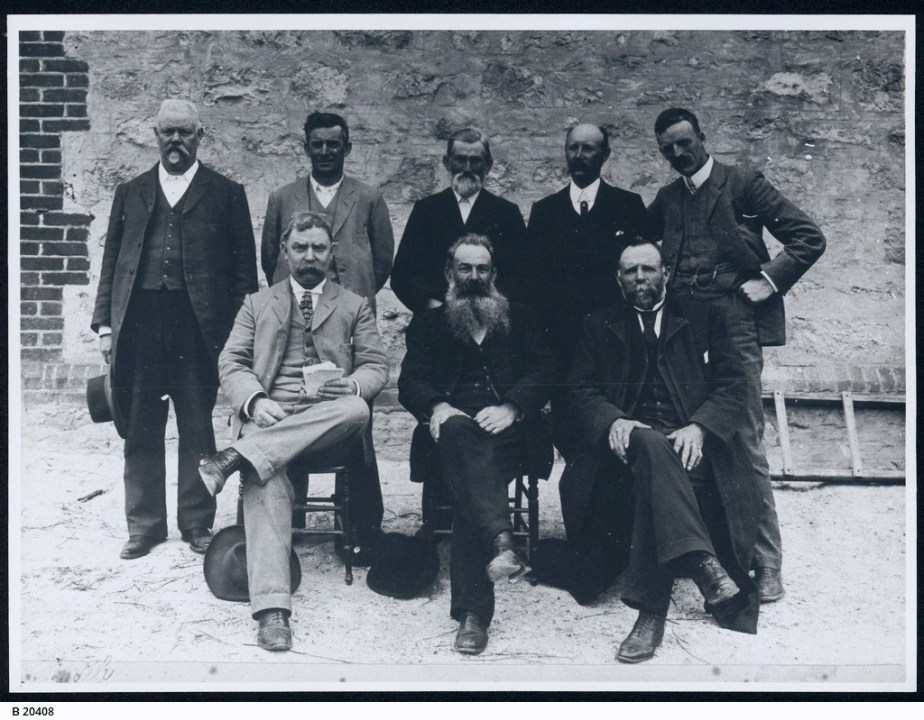
Back row, left to right: ? ; Heath Major; Aaron Jarrett; T. Taylor; Dr Nicholls. Front row: W.H. Gratwick; J.O. Tiddy; H.G. Tossell
History
The first official local government in Australia was the Perth Town Trust, established in 1838, only three years after British settlement. The Adelaide Corporation followed, created by the province of South Australia in October 1840. The City of Melbourne and the Sydney Corporation followed, both in 1842. All of these early forms failed; it was not until the 1860s and 1870s that the various colonies established widespread stable forms of local government, mainly for the purpose of raising money to build roads in rural and outer-urban regions.
In the 1970s, the Commonwealth Government expanded the level of funding to local governments beyond grants for road construction. General purpose grants became available for the first time.
Reforms
Significant reforms took place in the 1980s and 1990s in which metrics and efficiency analysis developed within the private sector were used by state governments in the local government arena. Each state conducted an inquiry into the benefits of council amalgamations during the 1990s. In the early 1990s, South Australia saw some reductions in the number of local governments while Western Australia and New South Wales rejected compulsory mergers. The main purpose of amalgamating councils was for greater efficiency and to improve operations, but forced amalgamation of councils is sometimes seen as a dilution of representative democracy.
An increase in the range of services offered by councils, but only minor cost savings of less than 10% have been noted by academics as outcomes after mergers. The council mergers have resulted in widespread job losses and lingering resentment from some whose roles have experienced a larger workload.
 The Maitland Watch