

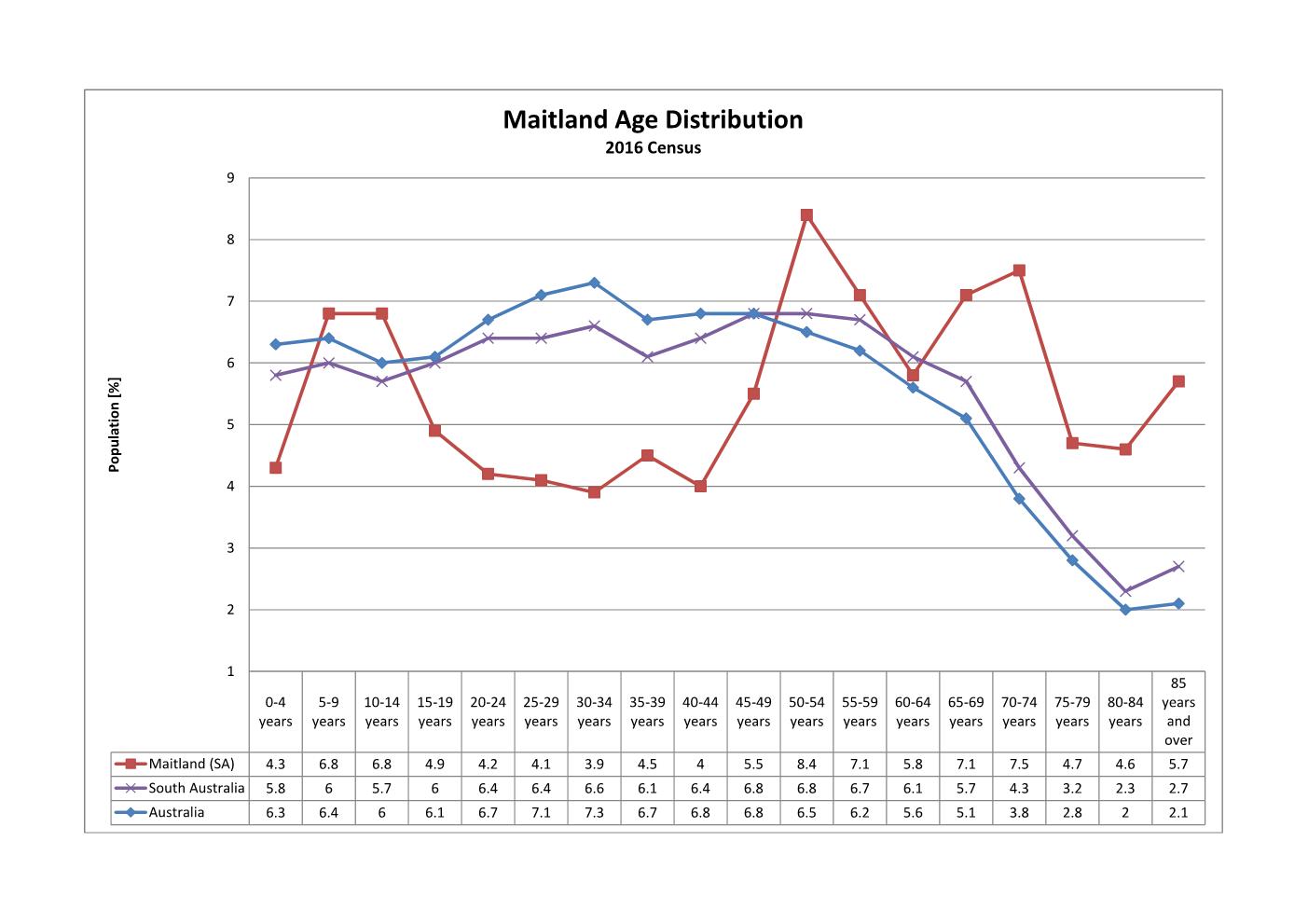
| Age [years] | Maitland (SA) | South Australia | Australia | |||
| Median | 50 | 40 | 38 | |||
| 0-14 | 17.9 | 17.5 | 18.7 | |||
| 15-50 | 31.1 | 44.7 | 47.5 | |||
| 50-65 | 21.3 | 19.6 | 18.3 | |||
| over 65 | 29.6 | 18.2 | 15,8 |
It is quite noticeable to anyone who spends a short while in this town that it has more than a usual number of elderly people, in fact 29.6% of the community are over 65. Include the number of people with disabilities, 22% according to council’s own publication ISO19, it is clear that this large segment of its rate paying community have deplorable facilities provided for their special needs.
The above statistics show that the town’s 29.6% of people over 65, is not only 63% more than the State value, but 87% more than the national value of 15.8%. This number of elderly is sustained by a shortage of a younger workforce, in the 15-50 age group which is 35% lower than the national average at 31.1%. The remaining workforce the 50-65 age bracket, follows the national average, but is each year, shedding retirees to the over 65 sector.
Referring to ISO19-2011; the Section entitled ‘Access Action Plan’, the council declares its … aims [are] to provide facilities as well as implementing services and programs which provide equitable access for people with disabilities. And that:
Council recognises the need for equitable access to services, premises, facilities and employment, as it is a right for people with disabilities and that improved access will advantage the community as a whole. Furthermore, Council recognises the need for inclusive policy, practices and procedures that are non-discriminatory. So:
The Access Action Plan facilitates changes to the physical environment as well as the culture of the Yorke Peninsula Council area through education and information, encouraging the community to consider the needs of the elderly and people with disabilities.
In essence these aims are more about suggesting to businesses and developers there may be benefits from them providing suitable facilities; and to the community encouraging us to consider the needs of the elderly and people with disabilities. In truth it is a veiled warning, because the requirements are implemented in the development approval process, at which time the applicant is told that certain facilities will have to be provided in order to satisfy these aims for approval.
As for the community education aspect, it appears to be misdirection to divert attention from the fact that council subtly ignores its obligation to provide and maintain many of these facilities, components of the streetscape, for which they have a duty of care in ensuring compliance with current standards and fitness for purpose.
 The Maitland Watch