

Welcome to the Maitland Waterworld tourist attraction proudly brought to you by your local council. But was it by design or just another mishap of willful blindness.
Lampooning aside we are grateful to the reader who emailed this dramatic photograph of flooding has it happened outside the post-office during Thursday’s hailstorm.
Note: Double-click on any picture to enlarge.
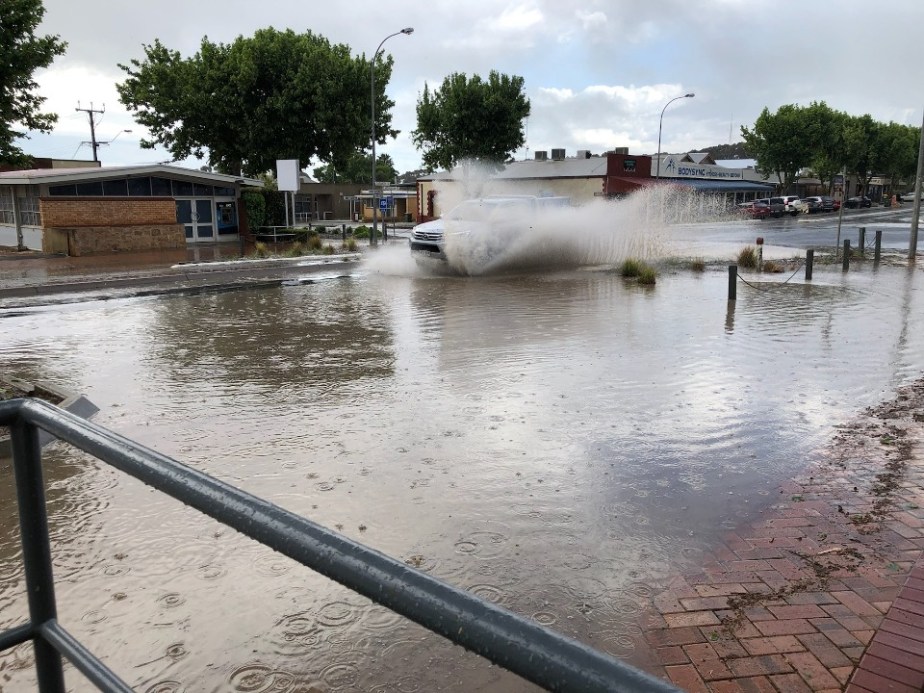
Courtesy of Rodney Phillips
The photo does raise some matters for concern:-
- The extent of ponding in such a short period;
- The submerged median strip, invisible to approaching vehicles;
- The danger of vehicles losing control on entering the pool;
- That it has pooled on a recently modified stormwater drain;
- The frequency of flooding since redevelopment of the Council Offices;
- The unusable footpath until the water has receded;
On the far end of the Park Terrace branch of the township drainage system the following photos were submitted by another reader showing the aftermath of the storm on the Seaview Road reach of this neglected 19th century drainage system.

Unmanaged storm-water flow along Seaview Rd emanating from Tiddy Ave and Park Tce. 28/10/21 
Unmanaged storm-water flow along Seaview Rd emanating from Tiddy Ave and Park Tce, continuing along the front of dwellings. 28/10/21 
Hailstones accumulated in front of the second dwelling as a result of an RFS modifying the front of the upstream property 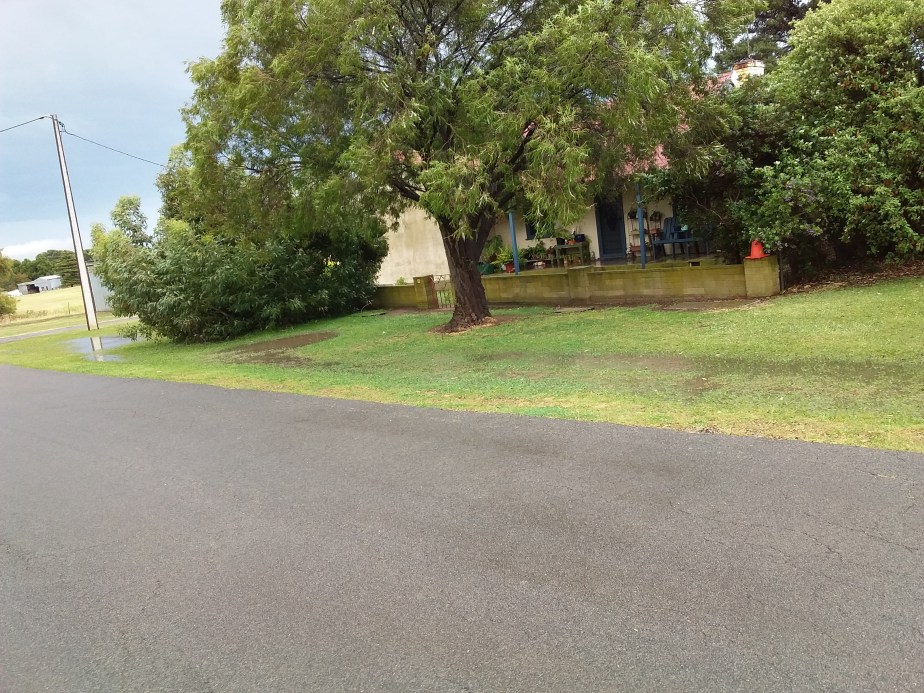
Unmanaged storm-water flow along Seaview Rd continuing along the front of dwellings. The red witches hat marks a telecom junction pit that gets flooded. 28/10/21 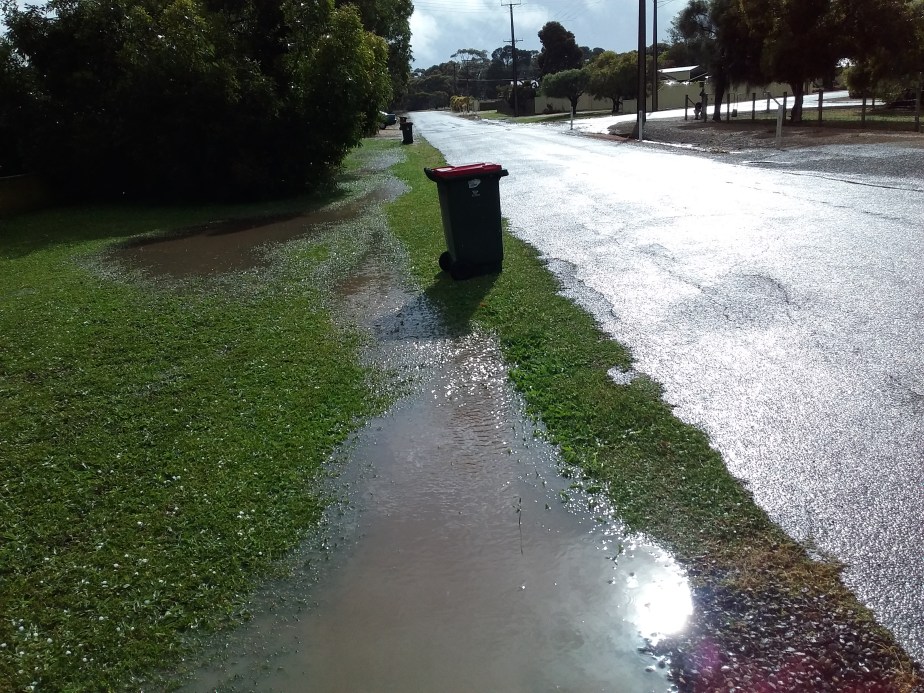
Storm-water further along the front of dwellings, prior to diverting into shed. 28/10/21 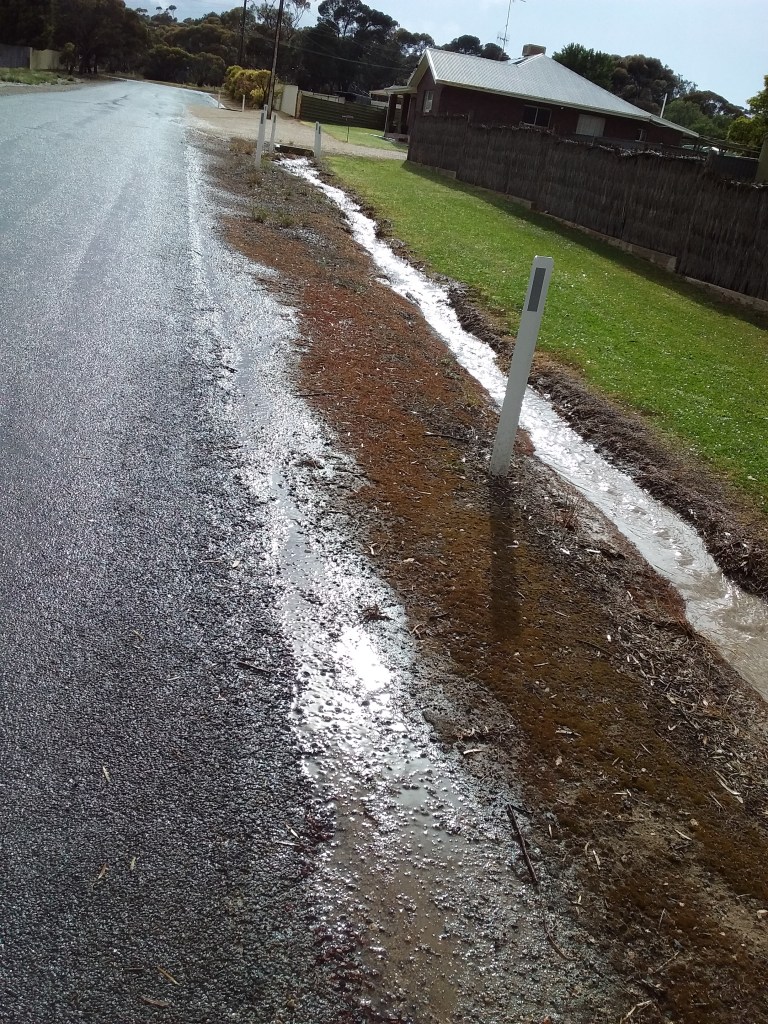
Hail-storm 28/10/21. Partially covered swale just down from Park Terrace 
Hail-storm 28/10/21. Flooding at the Yardea St/Seaview Rd confluence. 
Hail-storm 28/10/21. Flooding by design at the Yardea St/Seaview Rd confluence. 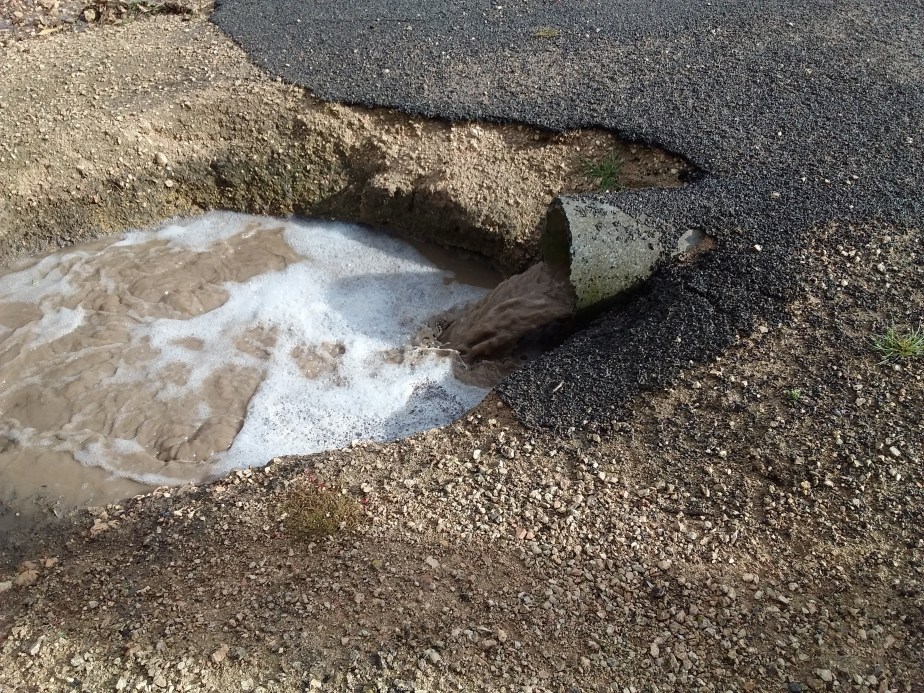
Unmanaged high velocity flow scouring downstream and undermining the undersized discharge pipe
Stormwater on this branch of the catchment starts its journey at the Pt Victoria Road end of Park Terrace and collects runoff from the houses, side streets and golf course en-route. At Tiddy Avenue it combines with some minor flows at the junction, before continuing down both sides of Seaview Road. Along Seaview Rd the flow is augmented by inflow from Yardea Ave draining the Western side of the catchment, then runs on to South Terrace.
Local Government Act 1999 :
Chapter 2—The system of local government
6—Principal role of a council
A council is, under the system of local government established by this Act, established to provide for the government and management of its area at the local level and, in particular—
(a) to act as a representative, informed and responsible decision-maker in the interests of its community; and
(b) to provide and co-ordinate various public services and facilities and to develop its community and resources in a socially just and ecologically sustainable manner; and
(c) to encourage and develop initiatives within its community for improving the quality of life of the community; and
(d) to represent the interests of its community to the wider community; and
(e) to exercise, perform and discharge the powers, functions and duties of local government under this and other Acts in relation to the area for which it is constituted.
7—Functions of a council
The functions of a council include—
(a) to plan at the local and regional level for the development and future requirements of its area;
(b) to provide services and facilities that benefit its area, its ratepayers and residents, and visitors to its area (including general public services or facilities (including electricity, gas and water services, and waste collection, control or disposal services or facilities), health, welfare or community services or facilities, and cultural or recreational services or facilities);
(c) to provide for the welfare, well-being and interests of individuals and groups within its community;
(d) to take measures to protect its area from natural and other hazards and to mitigate the effects of such hazards;
(e) to manage, develop, protect, restore, enhance and conserve the environment in an ecologically sustainable manner, and to improve amenity;
(f) to provide infrastructure for its community and for development within its area (including infrastructure that helps to protect any part of the local or broader community from any hazard or other event, or that assists in the management of any area);
(g) to promote its area and to provide an attractive climate and locations for the development of business, commerce, industry and tourism;
(h) to establish or support organisations or programs that benefit people in its area or local government generally;
(i) to manage and, if appropriate, develop, public areas vested in, or occupied by, the council;
(j) to manage, improve and develop resources available to the council;
(k) to undertake other functions and activities conferred by or under an Act.
Flood Control
Referring to the 1999 Local Government Act, the role and function of a council are cited above with clauses pertaining to stormwater management highlighted, a facility that has been badly neglected in this town in the following ways.
This flooding is the result of an archaic drainage system prolonged by a technically bereft organisation operating a policy of Willful Blindness managed as a Request for Service. An organisation we fund in good faith, in the belief that it has the expertise to at least identify the problems, which in this day and age are predominately technical. Yet it is obvious we employ no one suitably qualified, or is even prepared to visit a site at the time of an event to bare witness.
At the end of each financial year council publishes its Annual Report, and to justify their questionable achievements in the preceding year, feel the need to advise the reader of the magnitude of their responsibilities. In contrast it omits to state that these significant resources and assets are not managed by engineers experienced with the technicalities of draining 5900 km2 of catchment, or the safe design of 3,890 kms of varying road types, or the defense of 485 kms of coastline. Preferring instead to use the Ad Hoc services of private consultants to satisfy the apparent objective of cost saving.
Even if that were true it would be expected that a member of staff would have the technical experience, knowledge and ability to do the job if given the time and resources and be available to brief and oversee any outside expertise appointed. Not as occurs at present where inexperienced staff are left to grasp the nuances of plans they have accepted, then hire the wrong sort of certifier to assess them, then failing to recognise a request for further information is irrelevant, and wasting the time of the applicant, consultant and council.
If you would like to get notifications when new posts are published from this site. Please Subscribe below – subscription is FREE.
 The Maitland Watch