

Footpaths
The following is an extract from the attached report in which the appendix has a number of photographs
A Review of Published Guidelines on Public Footpaths
South Australian Government
In the “SA Guidelines for Disability Access in the Pedestrian Environment – 2009” the state Government; gave the following Policy Statement addressing the ‘information gap’ that exists between the knowledge to legally accommodate those with disabilities, when constructing transport infrastructure, and the information contained in Australian Standards, Guidelines, Codes etc.
…Promoting Independence is the State Government’s strategy to progressively improve disability access and inclusion across all funded services and to comply with the Disability Discrimination and Equal Opportunity Acts.
The aim of the strategy is to ensure that the services and products provided by all South Australian Government departments and their agencies are inclusive and accessible to people with a disability and to eliminate, as far as possible disability discrimination.
Followed by …DTEI promotes its commitment of ensuring the services and products it delivers appropriately accommodate people with disabilities via ‘Removing the Barriers’ Our Commitment to People with Disabilities. These guidelines are an example of how DTEI is delivering on its ‘Removing the Barriers’ commitment to people with disabilities…
Current version “Guidelines for Disability Access In the Pedestrian Environment Plan 2020-2022”
The Disability Discrimination Act 1992
The Disability Discrimination Act 1992 (DDA) is part of the package of federal anti-discrimination laws, which also includes the Racial Discrimination Act 1975, Sex Discrimination Act 1984, Human Rights and Equal Opportunity Commission Act 1986 and Age Discrimination Act 2004.
The DDA provides protection for everyone in Australia against discrimination based on disability. It encourages everyone to be involved in implementing the Act and to share in the overall benefits to the community and the economy that flow from participation by the widest range of people. Disability discrimination happens when people with a disability are treated less fairly than people without a disability. Disability discrimination also occurs when people are treated less fairly because they are relatives, friends, carers, co-workers or associates of a person with a disability.
A person with a disability has a right to access public places in the same way as a person without a disability. Denying or limiting access to public places by people with disabilities is against the law.
User Groups
Wheelchair Users
Being able to achieve goals is essential to an individual’s quality of life. Reaching a goal requires completion of one or more activities, involving a number of tasks. Each task must be possible to achieve in order for the goal, to be accessible. Many activities are away from a person’s current location and thus a journey has to be made to undertake such an activity.
To live a full and active life it is essential to participate in activities of daily living both in and outside of the home; for a wheelchair user this can present a major challenge. The ability to leave home to access services and participate in society greatly impacts on the quality of life. In Australia, wheelchairs are often funded by the authorities, who will also facilitate the adaptation of the user’s home to accommodate their needs and increase their ability to function within the home.
However, the outside environment is less adaptable to the individual as it must be accessible to the majority of people. A basic skill of any wheelchair user, be they the attendant or occupant, is to be able to push a wheelchair along a footway. More often than not in developed countries such as Australia, footways will have a lateral slope (crossfall) to aid surface water drainage; of (it is recommended) not more than 2.5%.
People who are unable to push themselves in a wheelchair are frequently elderly requiring an attendant to push them. These attendants (their carers) pushing the wheelchairs are likely to be a spouse, a child or a close friend and of a similar age to the occupant. The children of elderly people are commonly over the age of 60 with their own health issues which can affect their ability to push the wheelchair, which in turn affects the mobility of the wheelchair user (McIntyre & Atwal 2005).
Pedestrians
In general the disabled are part of a larger group, classed as pedestrians, who are among the most vulnerable group of road users. Not only do they have the least physical protection, pedestrian fatalities overly include the very young and the elderly. While some of these fatalities may be due to a number of factors, pedestrians are unprotected if involved in a crash. It is, therefore, essential to provide facilities that are well designed and appropriate to the particular situation to enhance pedestrian safety.
Currently one in five people in Australia have a disability. Two out of three people over 75 have a disability and the prevalence of disability will increase further with the ageing of the Australian population. It is estimated that the total number of people who identify themselves as having a disability will increase by about 38 per cent to around 632,600 by 2023.
Planning and designing good pedestrian infrastructure with well-connected and amenable facilities benefits the whole community. Encouraging people to choose walking as a mode of transport fosters more sustainable, healthier and safer communities. Independent travel becomes possible for more people including the elderly, children, families and people with disability.
In order to access any part of a town or city in the developed world, it is necessary to traverse a footpath. This is made clear by the European Conference of Ministers of Transport: “Almost all journeys start and finish by walking or wheeling. No matter how accessible transport itself may be, if the walking [or wheeling] environment contains barriers to movement then the usability of transport services is largely negated” (European Conference of Ministers of Transport 1999).
Footways form an integral part of the built environment worldwide. Many countries have introduced standards to ensure pavements do their job; to provide a safe and effective surface for people to use in order to access the buildings and services. Initially footways would have been used simply to walk along and to ensure they remained free from surface water, which causes problems regarding safety (people can slip in wet or icy conditions). However, in more recent times the needs of those who have some kind of mobility impairment need to be considered. This group consists of those who would have traditionally been thought of as being ‘disabled’ and as such need a form of assistive technology to aid them in traversing the pavements (such as wheelchair users and those who require a walking stick or crutches to keep their balance), to those who are impaired through their choice of shoes or amount of luggage they have decided to carry, or the child they need to push.
The Impact of Grades
Steep grades and cross slopes should be avoided where possible or integrated with level rest areas. Both powered and manual wheelchairs can become very unstable and/or difficult to control on sloped surfaces. When areas with steep sidewalks and ramps are wet, icy, or covered with snow, they have little or no slip resistance and a slide will usually end in the road.
Longitudinal grades
Longitudinal grades are often difficult to control in the sidewalk environment because sidewalks follow the path of the street. The sidewalk grade ideally should not exceed 5 percent. Design parameters developed for ramps on buildings and sites, permit a maximum grade of 7% for a distance of 9m before a level landing must be installed. Where the sidewalk grade approaches or exceeds that of the maximum permitted for a ramp, it is good practice to provide a level rest area. The slope of the level landing should not exceed 2.5%.
Cross Slopes
The maximum cross slope permitted by AS1428.1 is 2.5%. Severe cross slopes require wheelchair users and other pedestrians to work against the effects of gravity to maintain their lateral balance. Pedestrians using crutches or canes may be forced to turn sideways in order to keep their base of support at a manageable angle. Severe cross slopes can cause wheelchair users to veer towards the kerb and into the street (See Sketch 01).
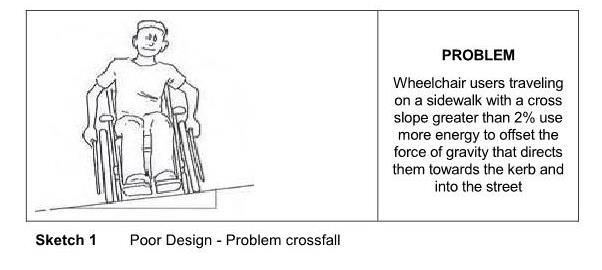
The impact of cross slopes is compounded when combined with steep grades and uneven surfaces. Designers and those constructing facilities need to understand the impact of grades and cross slopes and take particular care to stay within construction tolerances as well as within design standards. For sidewalks with steep cross slopes the designer can create a level area of at least 915mm within the pedestrian zone (See Sketch 02)
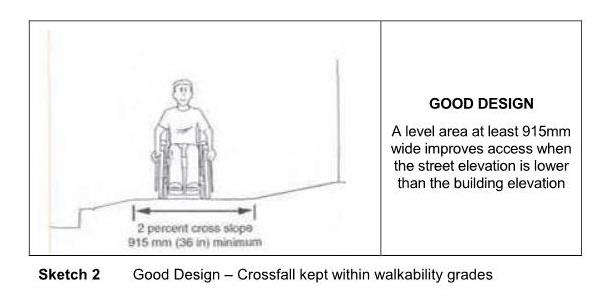
or increase the height of the kerb (See Sketch 03) The latter case can create problems for kerb ramp design and on-street parking (car doors may not be able to swing over the kerb).
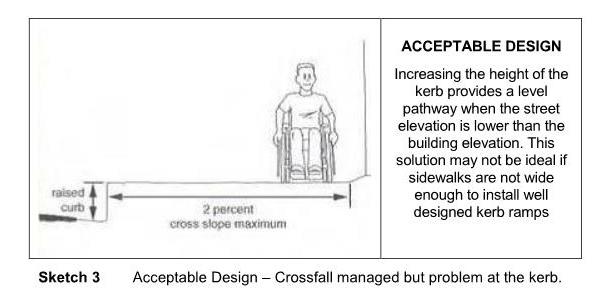
Increasing the height of the kerb provides a level pathway when the street elevation is lower than the building elevation. This solution may not be ideal if sidewalks are not wide enough to install well designed kerb ramps
Austroads : Longitudinal Gradient Design Criteria for Pedestrians
The Austroads publication “Guide to Traffic Engineering Practice, Part 13, Pedestrians” states that AS 1428.1 specifies the minimum requirements for steps, stairs and ramps. Ramps are defined as a convenient means of changes in level for people in wheelchairs or with prams.
A critical requirement to be resolved is the situation when AS 1428.1 is applicable. Although the context of AS 1428.1 is written for buildings, its scope states the standard is applicable to design requirements for building work to provide access for people with disability; with particular attention to be given to accessways, circulation spaces and consistent linkages for use by people in wheelchairs. Whilst the 1993 edition notes …although this Standard is intended to be used for the provision of access to buildings, in the absence of specific information, appropriate Clauses could well be applied to external locations such as walkways and landscaped areas…
• To arrive at a reasonable interpretation of AS 1428.1 the NCC 2016 Vol1 – Section D3.11 (a) states …a series of connected ramps must not have a combined vertical rise of more than 3.6m.
Opinion
As demonstrated in this article, relevant design information is and has been readily available for many years, from many credible sources either local, state, federal or internationally. Government policies have also been in place for many years with expectations clearly presented, such that even the most technically challenged bureaucrat could understand and implement if the will was there.
If you would like to get notifications when new posts are published from this site. Please Subscribe below – subscription is FREE.
 The Maitland Watch